Warm ups - part 1 - Pre Match
To begin this article, first we need some references in place so we can then objectively evaluate some recent pre match warm ups I have seen.
In every football match (and training) there are thousands of football actions performed, often many at the same time. But how can we define what a football action is?
Dutch football philosopher (and founder of Football Coach Evolution) Raymond Verheijen objectively defines a football action clearly, that it is objectively applicable for everyone. A football action is broken down as follows -
Communication - a player first needs to communicate with the environment, their team mates and the opponents, in order to assess the situation
Deciding what - once the player has all the information they need at that moment, the player then needs to decide WHAT they are going to do.
Deciding how - once the player has decided what they are going to do, they then need to decide HOW they are going to do it.
Executing the decision - once the player is decided how they are going to execute what they have decided, they can then execute the decisions.
We can now refer to this breakdown of a football action as CDE (Communicating/Deciding (what/how)/Execution. It’s an interaction in the context of football.
All around the world, I see the same warm ups from pretty much every team and they all follow a similar pattern. Based on the CDE reference above, how much of this are we really preparing for in the warm up? It is also worth considering at this point the constraints of football, which is what makes the game what it is. The constraints consist of a pitch, rules, opponents, team mates, one ball and two goals (take one of these things away so they are no longer present, then its no longer football - but that's for another day!). Ultimately the aim of football is to win by scoring at least one more goal than the other team. There are no points for completing passes. Passing is just a tool to help a team build up to create chances to score.
If we take the football action ‘passing’, this can only exist if a player is able to perform all of CDE. The player must communicate with the game situation (pitch, teammates, opponents, ball, goals), decide what to do, decide how to do it, and then execute the decision. If a player has nothing to communicate with, plus some of the constraints mentioned have been removed, then a football action can no longer be performed. So, if there are no opponents or teammates to communicate with, as a result there is no decision to make. In that moment, the player is no longer performing the football action ‘passing’. They are performing the basic action ‘kicking’.
In his book ‘Football Coaching Theory’, Verheijen describes a basic action as an interaction with a non specific environment. It could be performed on the roof of your house. So we could jump/land or sprint like we ask players to do but on the roof of your house. So it is not an interaction in the context of football (re the constraints of football which have already been highlighted)
Many so-called “passing exercises” remove the very constraints that define passing as a football action. When this happens, players are not training passing, they are training kicking. On top of that they are executing what the coach wants them to do (kick from one cone to another). Based on these objective references, these exercises are basic action exercises, not football action exercises.
To further illustrate the point, and the difference between a football action and a basic action, we can take the football action ‘pressing”. The basic action here is running (accelerating) and stopping (decelerating). If there is no opponent and I ask you to run and press a cone/mannequin, you are only performing running and stopping.
Pre game warm up 1
At a league 2 game recently I watched one team warm up and noted it down. Many of you will resonate with what they did, as it is considered the norm and everyone is comfortable with it. I previously would do this sort of warm up, until I understood how to critically evaluate my coaching actions. Anyway...this is what was noted -
For the first few minutes the players jogged in a straight line from one cone to another. They then broke off into a circle and performed a series of static stretches. Then they returned to the cones and performed some more straight line runs, with a gradual increase in speed.
Next the players went into a square that was 15x15 with 3-4 balls, and they took it in turns to kick the ball to each other after a few touches. Next they split into pairs, facing each other about 15-20 yards apart and kicked the ball to each other, gradually shortening the distance between the two.
After this the players went into a "keep ball" exercise in a 20x20 area, and played a game of 4v4+2 (jokers/floaters). They played 3 games of 1 minute.
When this was done, the starting defenders went off to play 4v0. The coach threw balls in the air for the players to jump and head the ball, or kicked the ball along the surface for them to control and kick back.
Whilst this was taking place, the rest of the players practiced shooting (kicking at goal), with a 1-2 with the coach before trying to kick the ball past the goalkeeper to score. It could be argued that players had more shots in 3-4 minutes than they would do in 2-3 games.
All outfield players then finished the warm up with 3 isolated sprints of 3 yards, and then 3 of 10 yards.
Let's not forget the goalkeeper, who warmed up catching, diving and long/short kicking all unopposed too.
Pre game warm up 2
The second warm up I noted in the same week was at a National League game. Again I watched one team and there warm up was as follows -
The warm up began with all outfield players kicking the ball to a team mate and following the direction of that kick, between two cones, 10 yards apart. This went into some jogging (forwards and backwards) between the cones, followed by jogging with arm swinging, skipping and sweeping their hands by their toes. When this was done, the players went into pairs and swung their legs up and down whilst leaning on each other. This part finished with some sort of running between the cones (what I mean by this is that it lacked any sort of acceleration or deceleration as it was more of a trot).
Then next came the kicking exercise. If you think about the number 5 on a dice, then the players were set up like this in two groups. A player at one to the bottom cones could kick into the man in the middle, who would then kick to one of the players at the top cones, and that player in turn would run with the ball back to the start. Players followed each kick to the vacant cone.
Now the team went into the "possession" game. They were put into three teams (blue, yellow and pink), each team with 4 players. For 3 games of 1 minute 45 seconds in a 10x20 area, there would be 4 pinks inside the area with 2 yellows. Two more yellow players would be opposite each other on the outside, and the blues had 2 players on the outside also opposite 2 players. The two yellows had to win the ball back from the pinks, who were also able to combine with all players on the outside. When the ball was won back, the yellows just gave the ball back to the coach to start again.
The warm concluded with midfield players kicking balls to each other over varying distances, the defenders played 4v0 very similar to what was described in the first example, and the forwards did some 1v0 shooting, with a few added crosses from time to time.
Again the goalkeeper practiced kicking, catching and diving, all unopposed.
Critical evaluation
Based on the CDE reference and the explanation of the difference between a football action and a basic action, my challenge to you the reader is can you evaluate the warm ups described in an objective way? Can you identify how much of each warm up was opposed (even without goals) and how much wasn't? How much looked like football according to the references and the constraints of the game, and how much didn't? Was warming up of CDE present a lot, a little or not at all?
With the references described at the start of this article, it's clear that both warm ups consisted of many basic actions, and “possession” (which is a tool for building up and creating goal scoring chances). There was no positional thought for players within both teams “possession” exercises, and no outcome related to the game. A whole football action (CDE) was not present in either warm up, as neither had direction as there were no goals used.
So how could we make improvements, whilst staying within the references we are using? Do we need a long kicking exercise, or would 1-2 minutes be enough? I understand that players will tell me they want some touches of the ball before an opposed game, and that's fine. Perhaps we could add in some other basic actions into the warm up and not just straight line work (changes of directions, jumping/landing, accelerating, decelerating etc).
Instead of a “possession” exercise why don't we think more about warming up CDE, which the players will be expected to perform thousands of times when the game begins. If we put players into their relevant playing positions and helped them to warm up CDE is it possible that this will help them more in games? What if we added some goals too? We could even add the goal keepers for this part? Some of you reading this will straight away think... what if I don't have the relevant goals to move around? Well there are always ways and means of being creative (poles, cones, portable goals that can go up and down quickly etc).
As I have tried to objectively critique these warm ups then I should try and provide a solution, based on the references this article has been based on.
Here's an example, using an area similar to the size of the penalty area.
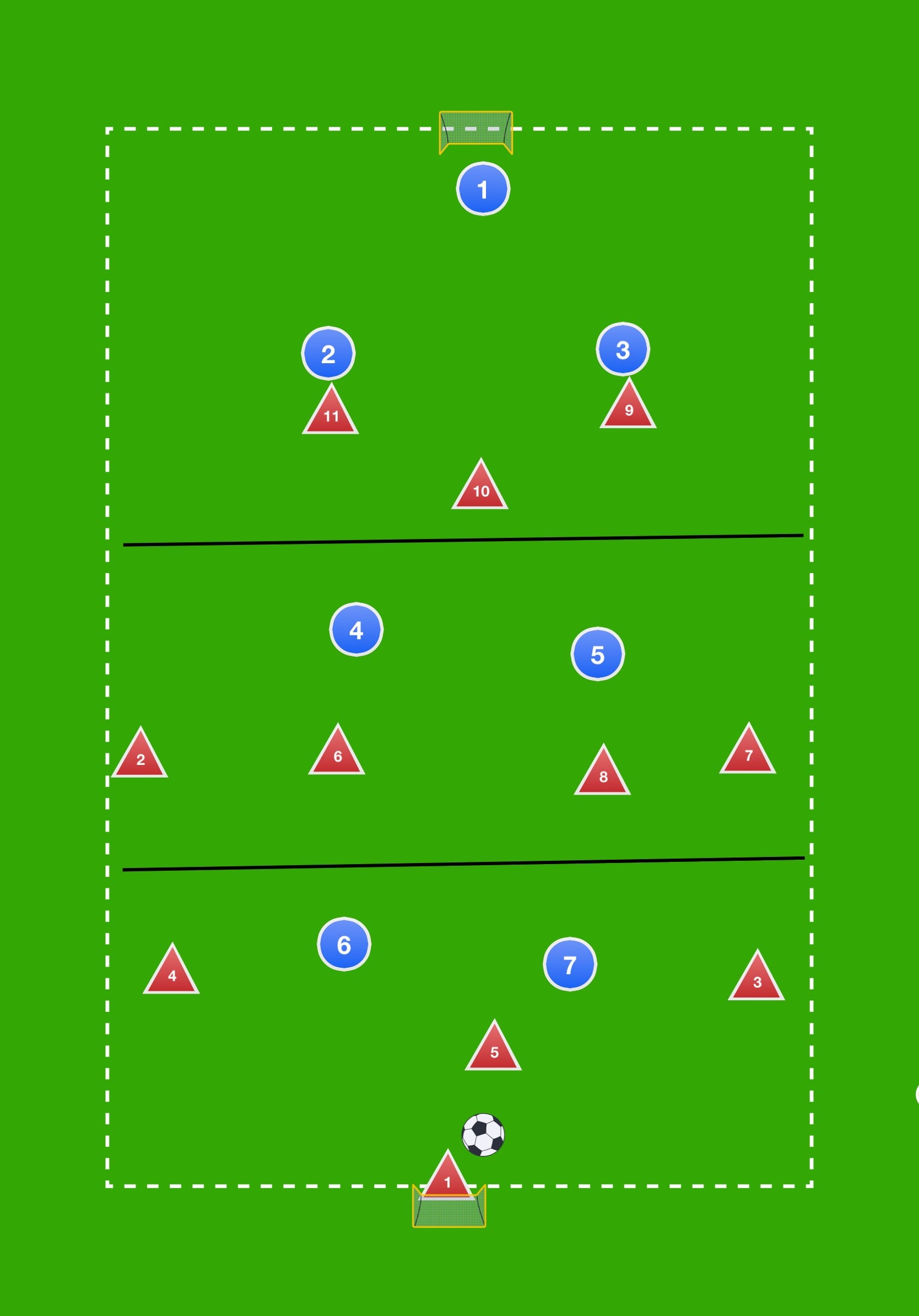
If the goalkeeper (or centre half if the goalkeeper coach is against his goalie joining in) starts with the ball there is an overload against the 2 blue players (blue 6 and 7). Same as we go up the pitch. This is a 11v7 exercise (with the goalies and subs included). The key thing here is for the blues to press the ball at 100% after the first pass. Now players will have to Communicate with the environment, their team mates and opponents, Decide WHAT they are going to do, Decide HOW they are going to do it and then Execute it. Now we have CDE present plus all natural constraints of the game. We have just reduced some aspects rather than take them away. By the way I think everyone should consider the best thing the goalie can do is to play the deepest pass possible.
With regards to defenders doing 4v0 work with the coach, can we not add in some duels (air and floor) to warm this up, as lets be honest these players are not going to get many free headers, and will have to duel more often than not with a direct opponent. And the strikers... does it have to be 1v0, or can we be creative and use subs or other non squad players to chase them down or try and stop them?
The interesting thing was a few years ago, the team I was working with, like most other teams, were more used to the warm ups I described in examples 1 and 2. However, I thought it would be interesting to experiment. So using our half of the pitch we played 10v7. The team of 10 had no goalkeeper as we were starting on the half way line. We played 6 reps of the 10v7 in accordance with our playing style. Basically the ten starting outfield players attacked everyone else (the opponent lined up with a goal keeper, 4 defenders and 2 centre midfielders as per their expected line up).
The feedback was really interesting from the players. Some loved it as it helped them to warm up what was coming. Others were really uncomfortable with it as it was a change from the norm described in examples 1 and 2.
If you have read this article, and you feel some stress or discomfort, ask yourself why. Are we really warming players up properly or can we do better?